
Facet Syndrome & Facet Disease
Pain stemming from the facet joints is known as facet syndrome. When the facet joints become inflamed, they can cause pain, soreness, and stiffness. It can occur at any part of the spine and depending on the location of the pain, facet syndrome symptoms will vary.
Anatomy
Each vertebra, there are 33 that make up the vertebral column, has four facet joints. Facets are the smooth, flat surfaces of the vertebrae that interlock and allow the spine to flex. Facet joints permit gliding movements between the vertebrae. These joints are in constant motion, providing the spine with the stability and flexibility needed to walk, run, bend, sit and twist.
Two of the joints connect the vertebra above; they are called superior facets. The pair that connects the vertebra below are called inferior facets.
Just like other joints within the body, each facet joint is surrounded by connective tissue and produces fluid to lubricate the joint. The surfaces of the joint are coated with cartilage, which helps each joint move smoothly.
What Is Facet Syndrome?
As we age, the cartilage that lines the facet joint surfaces gradually wears away due to constant, repetitive motions. In many cases, growths called bone spurs can develop. The bone spurs often grow along the edges of the bones and are most commonly found in joints.
Friction between the bones can cause tenderness, swelling, stiffness and facet joint pain. When seen in adults over the age of 50, facet syndrome can result in arthritis. Though generally the result of the natural aging process, facet joint syndrome may also be caused by an injury or overuse of certain joints while on the job or playing sports.
While facet syndrome can occur at any level of the spine, it is most common in the lower back or lumbar region.
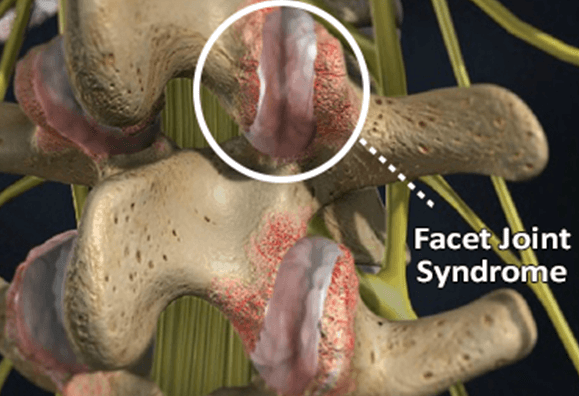
Types of Facet Syndrome
There are a number of terms used to describe facet joint problems or facet disease. In general, all of these terms mean the same thing; arthritis or degeneration of the facet joints, including:
Degenerative Facet Joints
Refers to the condition caused by degeneration and deterioration of the small joints of the spine due to the aging process. Degenerative facet joints mostly happen in the lower back, resulting in radiating pain in that area. Degeneration of facet joints may result in facet disease or facet arthritis.
Facet Arthritis
Refers to the condition caused by arthritic changes and inflammation that can develop in spine joints. Arthritis of the facet joints usually results in “referred pain” – i.e. the pain is perceived at a location other than the actual site of the problem.
Facet Hypertrophy
Refers to the condition caused by enlargement of one or more facet joints. One way that the human body responds to the aging process and degeneration of the spine is the enlargement of the facet joints to counteract the lost stability caused by degeneration. This enlargement can put pressure on the nearby nerves and therefore cause radiating pain. Facet hypertrophy mainly occurs in the lumbar region of the spine.
Causes of Facet Syndrome
Facet syndrome causes are generally the result of the natural aging process. However, the initial cause of facet syndrome may also be an injury, such as whiplash, or overuse of the joints.
Another possible cause of facet disease is spondylolisthesis, which is when one vertebra — usually in the lumbar spine — slips forward over the lower vertebrae. When the facet joints become inflamed due to injury or age, the result is stiffness and pain. As the facet joints deteriorate, they may also lose proper alignment, which can cause pain. Additionally, rubbing on the joints wears out the cartilage and fluid that lubricates them. As a result, bone can rub on bone, which results in painful back problems.
Symptoms of Facet Syndrome
Facets are compressed when an individual leans backward or to the side, so someone with a facet problem may feel pain in those positions. Leaning forward reduces the stress on the facet joints.
Facet syndrome symptoms related to facet joint problems are usually localized near the area of the facet joint. Therefore, symptoms differ depending on the location:
Lumbar Facet Joint Pain
- Lower back pain that may radiate into the buttocks and upper thigh area
- May be misdiagnosed as sciatica
Thoracic Facet Joint Pain
-
- Facet syndrome is in the thoracic region of the spine, which may result in pain in the central region of the spine, between the lower back and the shoulders
- One study suggests that referred pain from thoracic joint pain may appear as abdominal pain
Cervical Facet Joint Pain
- If the cervical vertebrae is affected, pain can occur in the back of the neck and radiate to the top of the shoulders and then radiate to the anterior neck
- Headaches at the base of the skull
Some other symptoms those suffering from facet syndrome may experience include:
- Pain that worsens in the beginning and end of the day or with changes in the weather
- Abnormal curvature of the spine
- Difficulty standing or sitting for long periods of time
Most patients will experience acute episodes of facet joint pain. Because the episodes ca be recurrent and unpredictable, some patients may believe it is all psychosomatic and the pain is being aggravated by stress.
When Does Facet Joint Pain Become Chronic?
When the facet joint pain lasts for three months or longer, it may be considered chronic and also may be referred to as facet joint syndrome. The facet joint pain may occur on its own or in combination with other conditions that cause low back pain.
Diagnosing Facet Syndrome
As with most spinal conditions, diagnosing facet syndrome begins with a thorough clinical evaluation, including a complete medical history, analysis of your symptoms and physical examination. Testing may include x-rays, MRI scan, or CT scan.
Pain related to facet syndrome can also be diagnosed through a diagnostic facet injection, a numbing medication, injected into the facet joint. To determine which facet joint(s) is the cause of the pain, medication is injected into the involved facet joints. The alleviation of pain supports the diagnosis that one or more facet joint(s) are the pain generator(s).
Treatment for Facet Syndrome
The type of pain you experience with facet syndrome is similar to many other spinal conditions. Accurately diagnosing the source of the pain is critical in obtaining facet syndrome treatment that will be successful.
Non-Surgical Treatment
Conservative treatments can be used to treat face joint pain. Some of the treatment options include:
- Soft tissue massage
- Spinal manipulation
- Back braces for correcting posture
- Anti-inflammatory non-steroidal drugs
- Muscle relaxers
- Physical therapy
Steroid injections can help relieve pain for a long period of time as well.
Surgical Treatment
The Bonati Spine Institute is the world leader in advanced spine surgery, and is also the first spine institute in the United States to receive FDA approval for the use of the Holmium YAG Laser in spine surgery. More than 80,000 successful procedures have been performed with proprietary procedures and instrumentation.
The Bonati Spine Procedures use specially designed probes and the Holmium YAG Laser to remove pain-inducing tissue in nerve branches above and below the affected facet joints on the spine. After a small incision is made, a tiny fiber optic camera is used to visualize and treat the exact facet problem area.
Prevention & Self-Care
As facet joint pain is linked to aging, it may not be entirely preventable. Still, adults can make some lifestyle changes in order to keep their back and spine healthy and prevent facet pain from becoming debilitating.
Some steps you can take to prevent facet joint pain include:
- Staying active and fit
- Eating a healthy diet
- Reducing stress
- Avoiding tobacco use
- Limiting alcohol consumption
- Improving your posture
The Bonati Spine Institute encourages patients with facet syndrome to contact us to request a no-obligation MRI review or discuss your conditions with our medical professionals. Find out why The Bonati Spine Procedures are considered to be among the world’s best solutions when it comes to advanced spine surgery. Your pain from facet syndrome can become a thing of the past.