
Spondylolisthesis
Overview
Spondylolisthesis is a condition in which a vertebra in the spinal column slips backward or forward and out of its original place. If a vertebra slips too much, it can press on a spinal nerve and cause pain. The term spondylolisthesis derives from two words: spondylo, which means spine, and listhesis, which means slippage.
Anatomy of the Spine
The spinal column supports your body and allows you to complete everyday movements like standing, bending down and twisting. The spine is made of 33 individual bones, known as vertebra. The vertebral column has a natural S-shaped curve, with each curve working to absorb shock, maintain balance and support your range of motion.
The vertebrae interlock with each other, but are split up into different sections, each of which has unique functions.
The cervical spine includes vertebrae C1 to C7, supports the weight of the head and allows neck movement.
The thoracic spine, or mid-back, holds the rib cage and protects the heart and lungs. The thoracic vertebrae are numbered T1 to T12.
The lumbar spine, or low back, includes the L1 to L5 and these vertebrae support the weight of the body.
Spondylolisthesis may occur anywhere within the spinal column, though, it is more prevalent in the lumbar spine.
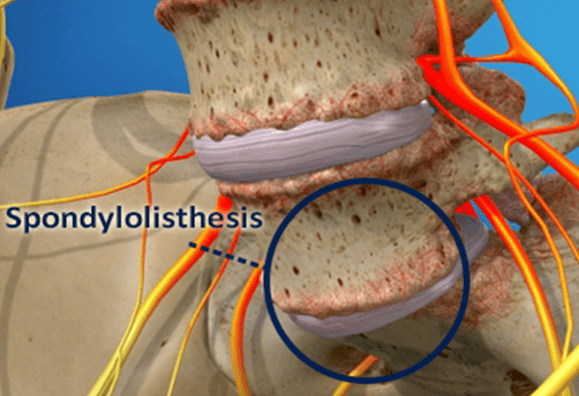
What is Spondylolisthesis?
Spondylolisthesis is a spinal condition that results when one of the vertebrae slips forward or backward when compared to the vertebra adjacent to it.
The condition is most commonly diagnosed in adults and caused by degeneration of the discs and ligaments that bind and support the spine. Spondylolisthesis often begins in the teenage years, and with age, the intervertebral discs lose water content and ultimately height. As the vertebrae on either side of the disc come closer to each other, the upper vertebra slides forward over the sub-adjacent vertebra.
Spondylolisthesis can also be associated with deterioration of the facet joints that connect vertebrae. As the facet joints become arthritic due to deterioration, they enlarge in an attempt to maintain the stability of the spine.
As the two vertebral segments adjoining the spinal canal slide past each other, the spinal canal narrows in size. The combination of spinal canal narrowing and enlargement of the facet joints produces nerve compression problems found in degenerative spondylolisthesis.
Causes of Spondylolisthesis
Men are more likely to develop spondylolisthesis than women. Some children under the age of five may also be pre-disposed to the condition. However, it is more common among children in the 7 to 10 years old range. Depending on the type, there are a number of different possible spondylolisthesis causes:
- Congenital condition
- Repetitive trauma
- Arthritic changes in the facet joints
- Direct trauma or injury to the vertebra
- Structural weakness of the bone
- Tumors or bone disease
Other risk factors that may lead to the development of spondylolisthesis include:
- Family history of back problems
- Previous back surgery
- Infections
- Chronic hypertension
- Playing high-impact sports
Types of Spondylolisthesis
There are several different types of spondylolisthesis with the most common being congenital spondylolisthesis, isthmic spondylolisthesis, and degenerative spondylolisthesis.
Congenital Spondylolisthesis
Congenital spondylolisthesis, also called dysplastic spondylolisthesis, indicates the condition is present at birth.
Spondylolisthesis can lead to a deformity of the spine as well as a narrowing of the spinal canal (central spinal stenosis) or compression of the exiting nerve roots (foraminal stenosis). Persistent pain associated with spondylolisthesis can lead to reduced mobility and inactivity. There is also a risk of permanent nerve damage if a slipped vertebra is pressing on a spinal nerve root.
Isthmic Spondylolisthesis
Specifically, isthmic spondylolisthesis occurs in a portion of the vertebra called the pars interarticularis. Isthmic spondylolisthesis can be caused by repetitive trauma and is more common in athletes exposed to hyperextension motions including gymnasts and football linemen. Isthmic spondylolisthesis can be the result of spondylolysis, a condition that leads to small stress fractures in the vertebrae.
Degenerative Spondylolisthesis
More common in older patients, degenerative spondylolisthesis occurs due to arthritic changes in the joints of the vertebrae due to cartilage degeneration. As you age, the spinal discs, which provide cushioning between the vertebrae, may lose water and be less able to resist movement by the vertebrae.
Less common forms of this condition include traumatic, pathological spondylolisthesis and post-surgical.
Symptoms of Spondylolisthesis
Spondylolisthesis symptoms can cause compressive or neurogenic symptoms. The forward slip of a vertebra also makes the spinal canal smaller, leaving less room for the nerve roots running between the vertebrae.
Compressive symptoms can also arise because the nerve roots at the segment involved are pinched with the narrow spinal canal. If there are compressive symptoms due to lumbar spondylolisthesis, there may be pain down the leg to the foot, numbness in the foot, and possibly weakness when trying to raise the foot.
The combination of spinal canal narrowing and enlargement of the facet joints produces the characteristics of nerve compression problems found in degenerative spondylolisthesis.
- Lower back pain
- Buttock pain
- Pain that runs down the back of the leg
- Weakness in the legs
- Tingling or numbness
- Pain that gets worse with a twist or bending over
- Muscle strain-like discomfort
- Muscle spasms in hamstring muscles
- Difficulty walking or standing
- Diagnosing Spondylolisthesis
Examination and Diagnostic Studies
Most of the symptoms from spondylolisthesis are aggravated by standing, walking and other activities. The first step in diagnosing the condition is a physical examination. You may have difficulty lifting your leg or completing simple exercises.
Imaging studies such as an MRI and CT scan are used to confirm the condition and demonstrate the degree of slippage in spondylolisthesis. The doctor may also use x-rays to look for any possible bone fractures, which could be the cause of nerve impingement or spondylolisthesis.
Grading Spondylolisthesis
After a physical exam and imaging studies are completed, a radiologist will determine to what degree slippage occurred. Spondylolisthesis may fall into four grades.
- Grade I – Vertebral slip of up to 25%
- Grade II – Slip between 26% and 50%
- Grade III – 51% to 75% slip
- Grade IV – 76% to 100% vertebral slip
Treatment for Spondylolisthesis
Spondylolisthesis treatment will primarily depend on what type of spondylolisthesis it is and what symptoms the patient is displaying. Surgery may be necessary for spondylolisthesis treatment if medication, physical therapy, and exercise fail to keep the spondylolisthesis pain at a tolerable level.
Non-Surgical Treatment
Conservative treatment is common for Grade I and II spondylolisthesis. Treatment options may include:
- Decreased activity until pain subsides
- Over-the-counter anti-inflammatory drugs (NSAIDs), such as ibuprofen
- Epidural steroid injections
- Back support or brace
- Physical therapy for improving flexibility and muscle strength
Surgical Treatment
Surgical treatment for spondylolisthesis must address nerve compression symptoms if they are present. This usually means that the nerves that exit the spine must be freed of all pressure and irritation.
The Bonati Spine Procedures offer an array of surgical techniques to treat spondylolisthesis, which may include:
- A laminotomy/laminectomy , which is a decompression surgery for spinal stenosis and involves making an opening in the lamina to relieve pressure on the affected area and allow the nerve roots room to heal. This procedure is often utilized in order to give the surgeon the proper space to perform a foraminotomy/foraminectomy.
- A foraminectomy/foraminotomy, which is a decompression surgery, performed in order to increases the space of the foramen and hollow out the passageway where the nerve roots exit the spinal canal. The procedure involves the removal of bone or tissue that obstructs the neuroforamen and compresses the nerve roots leading to inflammation and radiating pain. During this procedure, the surgeons utilize specialized instrumentations to decompress the nerve roots as they exit through the foramen.
- A discectomy, which involves the removal of a portion of the intervertebral disc that is putting pressure on the spinal cord or radiating nerves. A discectomy may be performed as part of the treatment for spondylolisthesis if the disc at the affected level is herniated.
Prevention & Self-Care
As spondylolisthesis may be the result of congenital and genetics, it is not fully preventable. Still, there are many steps you can take to reduce the risk of a vertebral slip.
- Maintain the strength in your back and abdominal muscles
- Maintain a healthy weight
- Eat a well-balanced diet
- Protect your back during sports or rigorous activities
- Correct your posture
- Stop smoking and avoid excessive consumption of alcohol
- Learn to lift correctly
By following these tips, you can enjoy the benefits of a healthy spine at any age.
Outlook
Persistent pain as a result of spondylolisthesis can reduce mobility and lead to inactivity that can result in weight gain, loss of bone density, muscle atrophy and loss of flexibility.
The outlook for someone with spondylolisthesis depends on the grade of the slip. In the case of a minor slip, the individual may not suffer from a recurrence of back pain related to the condition because the nerves are not being impinged.
If the slip causes nerve compression, surgery may be required to decompress the nerves that are causing the pain.
The Bonati Spine Institute encourages patients with spondylolisthesis to contact us to request a no-obligation MRI review or discuss your conditions with our medical professionals. Find out why The Bonati Spine Procedures are considered to be among the world’s best solutions when it comes to advanced spine surgery. Your pain from spondylolisthesis can become a thing of the past.