


|
Following are descriptions of the various Bonati Procedures. Click on the procedure title for more information.
|
Dictionary
The mission of The Bonati Institute is to provide hope to people suffering with chronic pain from a back or neck condition. We believe that a well-informed patient is vital to restoring hope and finding answers to pain. We developed this web site primarily to help educate pain sufferers and their families. We’ve found that the more individuals in pain learn about their anatomy, their condition and the options available to them the more likely they will be to choose the advanced arthroscopic procedures offered by The Bonati Institute.
Result:
- Arthroscopic surgery - Surgery that uses fiber-optic tools to view problem areas. A small incision is made and a small endoscopic tube is inserted through which the entire surgery is performed.
- Bone Spurs - Form as a result of degenerative disk disease or spinal arthritis and they narrow the foramen, eventually causing spinal stenosis. Bone spurs are also known as osteophytes.
- Bulging disc - A herniated disc.
- Cannula - A slender tube that can be inserted into a body cavity or duct.
- CAT Scan - Pictures of structures within the body created by a computer that takes the data from multiple X-ray images and turns them in pictures on a screen. The CAT (Computerized Axial Tomography) scan can reveal some soft tissue and other structures that cannot even be seen in conventional X-rays.
- Cervical - Having to do with the neck.
- Chronic pain - Pain that persists or progresses over a long period of time.
- Compression - Applying pressure.
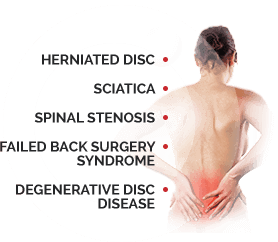
- Degenerative Disc Disease - The discs that stack the vertebrae are partly composed of cartilage. The gradual deterioration of the discs between the vertebrae is referred to as degenerative disc disease.
- Discectomy - Excision, in part or whole, of an intervertebral disk.
- Endoscope - A lighted optical instrument used to get a deep look inside the body and examine joint passageways.An endoscope can be rigid or flexible.
- Facet - Interlocking bones on the vertebrae which allow the spine to flex while maiuntainingn its stability.
- Facet Debridement - A procedure used to treat degenerative joint disease due to "facet syndrome" or "facet arthritis". A laser is used to vaporize painful nerves around the structure.
- Failed Back Surgery Syndrome - Failed back surgery syndrome is seen in 10-40 percent of patients who undergo "open" back surgery. It is characterized by intractable pain and varying degrees of loss of function following spine surgery. The cause is usually recurrent herniated discs and scarring.
- Foramenoplasty - A foramen is the window through which a nerve root exits the spine. Bone spurs that form as a result of degenerative disc disease or spinal arthritis may narrow the foramen, causing spinal stenosis. Foramen may also be narrowed by a herniated disc or scar tissue from a previous surgery.
- Foraminal Narrowing - Foraminal narrowing or stenosis may arise without any disc herniation. The majority of symptoms are usually caused by one nerve root on one side.
- Herniated Disc - A painful rupture of the cartilage between vertebrae occurring most often in the lumbar, or lower back, region.
- Herniated nucleus pulposis - A protrusion of the soft inner disc material following a disc herniation.
- Holmium YAG Laser - A very small, yet powerful, laser used for the precise needs of intricate arthroscopic surgery.
- Hydrotherapy - The use of water in a medical treatment.
- Laminectomy - A surgical procedure to relieve pressure on the spinal cord or nerve root caused by a slipped or herniated disc in the lumbar spine. This procedure is also used in the treatment of spinal stenosis.
- Laser Arthroscopy - Lasers use light as a source of energy transmission, replacing many of the common surgical tools used in "open" procedures. A laser can be used to remove calcium, scar tissue, and bone. It can also be used to cauterize cervical, thoracic, lumbar, knee, shoulder, and carpal tunnel areas.
- Level - The space between two vertebrae in which a nerve could be compressed.
- Lumbar - Refers to the 5 lumbar vertebrae that are situated in the lower back region, below the thoracic vertebrae and above the sacral vertebrae in the spinal column.
- MAC anesthesia - (Monitored Anesthesia Care) Conscious sedation.
- Microsurgery - Reconstructive surgery on small body parts performed under magnification using delicate instruments and precise techniques.
- Mild, Medium, Severe Compression - The level of intensity with which a nerve is compressed.
- MISS (Minimally Invasive Spinal Surgery) - Advanced spinal surgery that uses fiber optic procedures and tools to view problem areas. A small incision is made and a small endoscopic tube is inserted through which the entire surgery is performed.
- MRI - Common abbreviation for Magnetic Resonance Imaging. MRI images, particularly of soft tissue, brain, and spinal cord are three-dimensional and are superior in detail to the usual X-ray image.
- Myelogram - An X-ray of the spinal cord and the bones of the spine. During a myelogram, a contrast material that is injected into the spinal canal is used to visualize the structures of the spinal cord and nerve roots.
- Nerve Block - A nerve block is a form of anesthesia in which medication is injected near a nerve so that signals from the nerve cannot pass through.
- Nerve Pathway - A nerve pathway may run upward (ascending pathway) from the spinal cord toward the brain carrying sensory information from the body to the brain. In contrast, descending pathways are nerve pathways that go down the spinal cord and allow the brain to control movement of the body below the head.
- Nerve Roots - Each spinal nerve is connected to the spinal cord at two places: the anterior root and the posterior root.
- Neurological - Having to do with the nerves or the nervous system.
- Neurosurgery - A surgical specialty for the treatment of diseases and disorders of the brain, spinal cord, and peripheral and sympathetic nervous system.
- Open Back Surgery - Traditional back surgery where a long incision is usually made.
- Orthopaedics -The branch of surgery broadly concerned with the skeletal system (bones).
- Physiotherapeutics - Of, or relating to, or used, in physical therapy.
- Pinched Nerve - Spinal nerves emerge from the spinal cord through gaps between the main body of the vertebrae and the facet joints. One frequent cause of back pain is a worn facet joint, which can pinch the spinal nerve.
- Radicular - Of, or pertaining to, nerve roots.
- Radiculitis Radiculitis or Radicular Pain, is transferred pain "radiated" along the path of a nerve due to pressure on the nerve root at its connection to the spinal column.
- Radiculopathy - Any disease of the spinal nerve roots or spinal nerves. It is synonymous with radiculitis. Radiculopathy is characterized by pain that seems to radiate from the spine and extend outward to cause symptoms away from the source of the spinal nerve root irritation.
- Sciatic Nerve - The largest nerve in the body. The sciatic nerve begins from nerve roots in the lumbar part of the spinal cord (the low back) and extends through the buttocks down to the legs. Pain resulting from irritation of the sciatic nerve is called sciatica. The pain is typically felt at the back of the thigh.
- Sciatica - Pain resulting from irritation of the sciatic nerve, typically felt from the low back to behind the thigh and radiating down below the knee.
- Scoliosis -Sideways (lateral) curving of the spine.
- Slipped Disc - Rupturing of the tissue that separates the vertebral bones of the spinal column. A slipped disc is also known as a herniated disc.
- Spinal Fusion - Correction of an unstable part of the spine by joining two or more vertebrae; usually done surgically but sometimes done by traction or immobilization.
- Spinal Stenosis -
Narrowing of the spaces in the spine, resulting in compression of the nerve
roots or spinal cord. This occurs most often in the lumbar spine (the low
back) but also occurs in the cervical spine (the neck) and less often in
the thoracic spine (the upper back). Spinal stenosis is most often caused
by degeneration of the discs between the vertebrae due to osteoarthritis.
Pressure on the lower part of the spinal cord or on nerve roots branching
out from that area may give rise to pain or numbness in the legs.
- Spondylolisthesis
- Forward movement of one vertebra over an adjacent vertebra.
- Thoracic -The 12 thoracic vertebrae are situated between the cervical (neck) vertebrae and the lumbar (lower back) vertebrae. The thoracic vertebrae are represented by the symbols T1 through T12.
- Whiplash -This is an imprecise term for injury to the cervical vertebrae and adjacent soft tissues. It is produced by a sudden jerking or relative backward or forward acceleration of the head with respect to the vertebral column.
© 2005 The Bonati Institute. All rights reserved.
Bonati, The Bonati Institute and The Bonati Procedures are service marks and are the property of
Medical Development Corporation of Pasco County d/b/a The Bonati Institute.
|
| Address: |
7315 Hudson Ave
Hudson, FL
34667 |
| Phone: |
(866) 298-7513 |
| Fax: |
(727) 697-3310 |
|
Map |
|
|